
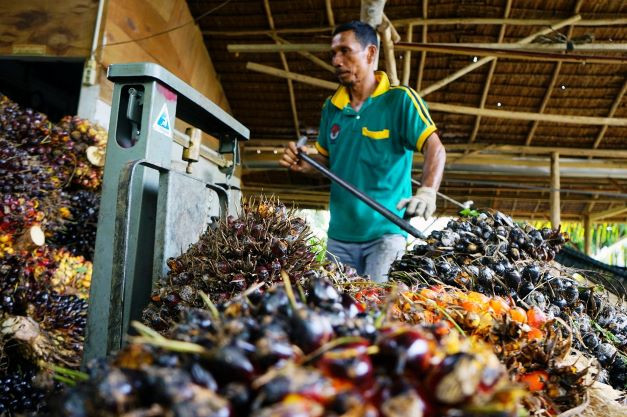
“Not everyone wants to plant oil palm. Other crops can be planted such as coffee. Palm oil plantations in Indonesia are already very large, approximately 13 million hectares and the annual production is 42 million tons. If it’s too big, the price will go down,” Jokowi said in mid January in Taman Pinus, Kenali, Jambi City when submitting a Social Forestry Decree for a land area of more than 91 thousand hectares to 8.100 farmers in Jambi Province.
Jokowi’s invitation does not seem excessive. This is because research results from the Indonesian Greenomics Non-Governmental Organization show that the total release of state forest areas for plantation permits to certain large-scale business players reaches more than 2,4 million hectares. The area is more than 36 times the size of Jakarta.
More than 90 percent of the plantation permits issued have been granted to businesses for oil palm plantation expansion. Not surprisingly, the process of extensification or expansion of oil palm plantations in 2018 according to the Ministry of Agriculture (Kemtan) records, as reported Cash, reaching 14,03 million hectares, with an average growth of land area for oil palm plantations reaching 10,31 percent every year.
Oversupply of CPO
Soil and climate conditions in Indonesia are indeed suitable for oil palm plantations. The contribution of palm oil exports is also one of the highest among the other five commodities. Association research results Prakarsa Mentioned that palm oil was the largest export-contributing commodity in Indonesia from 1989 to 2017, with an average growth in the value of palm oil exports per year reaching 2.782 percent.
Palm oil productivity is higher than other types of plants in producing vegetable oil. The level of palm oil production reached 3,6 tonnes per hectare per year for the period 1970-2017. Currently, Indonesia’s CPO production is 44 million tons to 46 million tons per year, with a land area of 14 million hectares.
The Agency for the Assessment and Application of Technology (BPPT) estimates that palm oil production will reach 51,7 million tons by 2025. If this continues, conditions oversupplyCPO could hit Indonesia in 2030. According to the head of BPPT, Hammam Riza, this condition is like a double-edged sword.
If the excess palm oil production can be absorbed by the market, then this is very good for the industry, including the welfare of farmers. On the other hand, oversupply this palm oil production can also lead to oversupply which in turn makes the selling price of this product lower.
Because, according to the prevailing economic law, “If the production volume exceeds market demand, the excess supply will cause the selling price to fall. Of course, this is detrimental to farmers and oil palm plantation entrepreneurs,” Hammam explained Tirto.
For the record, data from the Indonesian Palm Oil Association (GAPKI) shows that exports of palm oil (Crude Palm Oil/CPO and its derivative products, biodiesel and oleochemicals) as a whole reached 34,71 million tons in 2018. This figure increased by 8 percent from 32,18. ,2017 million tons in 20. Meanwhile, domestically, biodiesel absorption through the B3,8 program reached 2018 million tons in 72, up 2017 percent compared to XNUMX.
Innovation and Diversification
With this estimate of overproduction, the government needs to take various measures, including diversification in the management and use of palm oil. What the government can do in the near and medium term is to control the level of production of palm-based products to suit market needs.
“A detailed analysis is needed, so that market needs can be predicted more accurately so that Indonesia can carry out production planning more maturely,” explained Hammam.
The next step is to open new markets. One of the ways the government can do, according to Hammam, is to innovate in the downstream sector, he continued, by processing palm oil into processed products with higher added value. For example, by producing more biodiesel.
If this can be done, then Indonesia can export biodiesel at a price equal to the Mean of Platts Singapore (MOPS) to destination countries such as China, India, Japan, Saudi Arabia and South Korea. Overall, these countries are able to consume 28,8 million barrels per day.
Diesel consumption in these countries reaches 568 million kiloliters per year. Therefore, continued Hammam, if Indonesia is able to lobby these countries and promote domestic production of B1, then there will be an absorption of at least 5,68 million kiloliters of biodiesel.
“It would be better if Indonesia could promote B-25, so biodiesel absorption could increase by another 14,2 million kiloliters. Almost all industrial segments have no objection to using 2,5 percent biodiesel. In this way, the current biodiesel plant idle, can be fully utilized,” said Hammam.
Use of CPO for refineries green fuel, for example, it is also a feasible technical alternative to be taken as a mitigation measure oversupply CPO.
In addition to market diversification, the government should also carry out downstream and product differentiation related to palm oil, said Hammam. Steps that can be taken, for example, are to utilize the waste management of palm oil plantations to be further processed into liquid fuel (Bio Crude Oil) to other uses, such as pulp or paper.
In addition, the diversification of palm oil in fuel oil (BBM) will also reduce Indonesia’s diesel imports. Indonesia’s fuel consumption continues to rise every year and creates an import deficit of USD 13,4 billion. “There must be an effort to reduce imports by diversifying,” continued Hammam.
Currently, the government continues to review the application of 30 percent biodiesel (B30). Later, B30 is predicted to save 9 million kiloliters (KL) of diesel imports, equivalent to US$ 6 billion.
Condition oversupply CPO, according to the General Chairperson of GAPKI Joko Supriyono, has actually been happening for the past two years. In fact, GAPKI estimates that excess palm oil production will last until at least 2023, if the Indonesian government does not take certain steps as mitigation.
For example, said Joko, by ensuring the implementation of B20 as a whole or 100 percent. If this step is actually realized, then there is hope that 5 million CPO will be absorbed as B20 raw material.
In addition, accelerating the absorption of CPO directly by the State Electricity Company (PLN) can also help with mitigation measures. Reported Cash, there are four power plants that are conducting trials using CPO as fuel directly.
The four power plants are the Kanaan Bontang Diesel Power Plant (PLTD) with a capacity of 10 megawatts (MW), the Batakan Balikpapan PLTD (40 MW), the Supa Pare-Pare PLTD (62 MW), and the Jayapura Gas PLT (PLTMG) with a 10 MG capacity. To supply the four power plants, PLN requires around 190 thousand kiloliters of CPO per year.
Other mitigation measures to address oversupply CPO is also by doing replanting or plant rejuvenation. According to Joko, in the midst of the current downward trend in CPO prices due to overproduction and the ban on CPO exports in European Union countries, steps replanting is the right thing to do.
Replanting has two effects, namely short term because it can reduce incrementable supply or additional supply of CPO, as well as the long-term effect of better CPO productivity.
Despite all that, Joko said that the most important thing that Indonesia should pay attention to regarding palm oil is the sustainability of the CPO market itself. “Presence or absence oversupply CPO, what needs to be considered is sustainable markets Indonesian CPO is an export market, for the long term,” said Joko.
Adapted from : https://theprakarsa.org/en/ketika-indonesia-dihantui-oversupply-produksi-sawit/
Author : Dea Chadiza Syafina